Mandelbulb Julia Sets
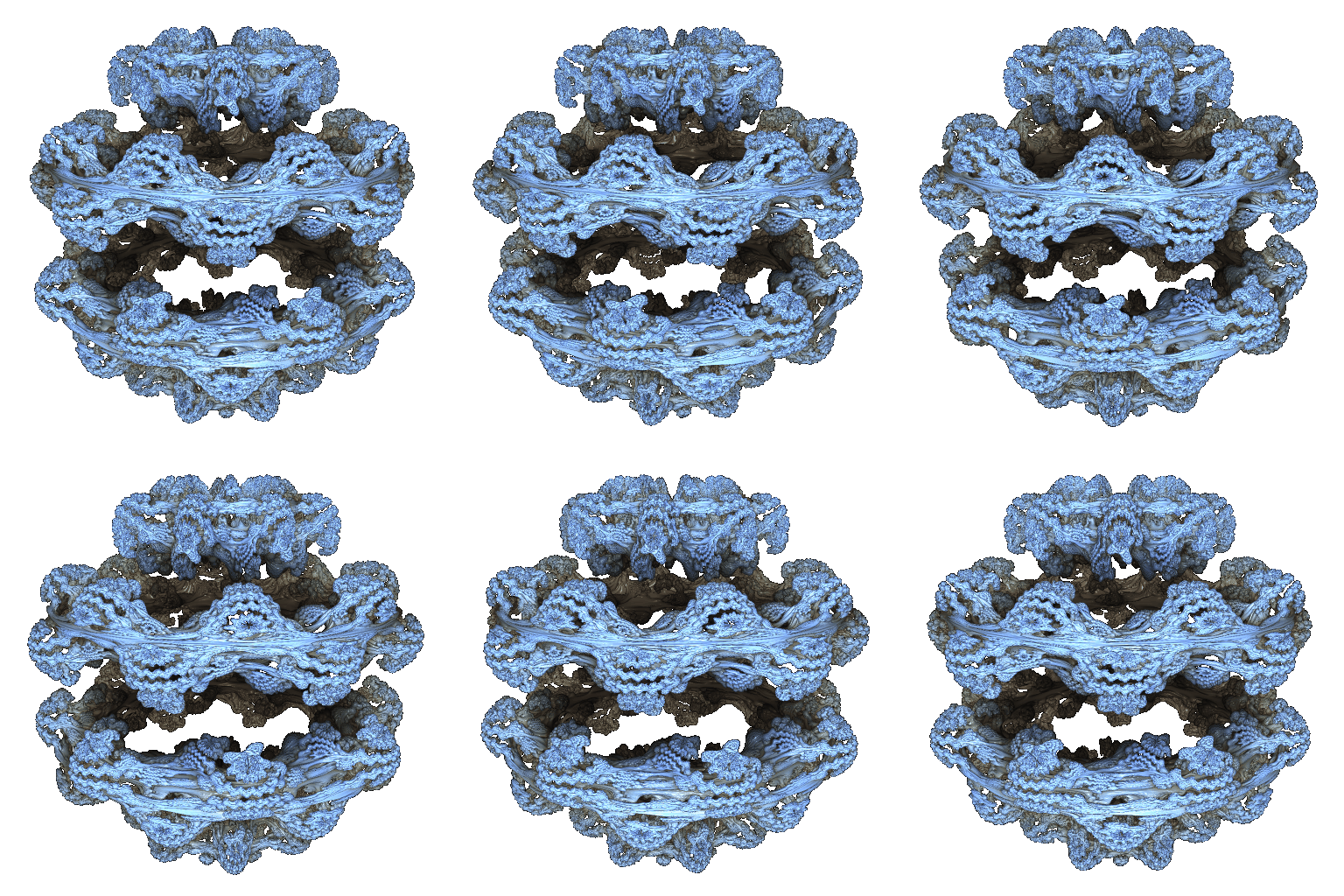
Julia sets exist for most iterated fractal equations, not just the Mandelbrot set. Any fractal of the form Zn+1 = f(Zn) + C has corresponding Julia sets using the same definition where C is the constant Julia point, and the initial value Z0 is the point on the graph to test. The Mandelbulb is no exception. Being a 3D version of the Mandelbrot set, almost all of the same properties apply to its "Juliabulb" sets:
- Wherever the point is, the Julia sets contain a snapshot of only those fractal features. Near the top, the Julia sets are all wavy rings, and near the equator they are swirled bulbs!
- The Juliabulb sets have a symmetry degree of one more than the Mandelbulb of the same power.
- If the Julia point is inside the Mandelbulb, the Julia set is also a connected bulb, and if it's outside, the Julia set is a disconnected cloud of swirls.
The spinning Juliabulb at the top of the page is at C = (0.749, 0.201, 0.557), which is outside the Mandelbulb, so the Juliabulb is a hollow maze of floating bulbs and swirls. Examine this close-up of the middle ring. The disconnectedness goes infinitely deep. Every floating disconnected swirl is composed of many disconnected swirls, themselves composed of infinitely many more disconnected swirls!

With a power-2 Mandelbulb, the connection to the Mandelbrot set is clear. The Julia sets have the same general shape and pattern at the same points. However, these sets are 3-dimensional, having the same pattern of swirly arms in all directions! Click on them to open the viewer, where you can rotate it.


The symmetry also follows the same rules as for the Mandelbrot set. For example, a power-6 Mandelbulb has 5-fold symmetry, but a power-6 Juliabulb has 6-fold symmetry and resembles snowflakes!


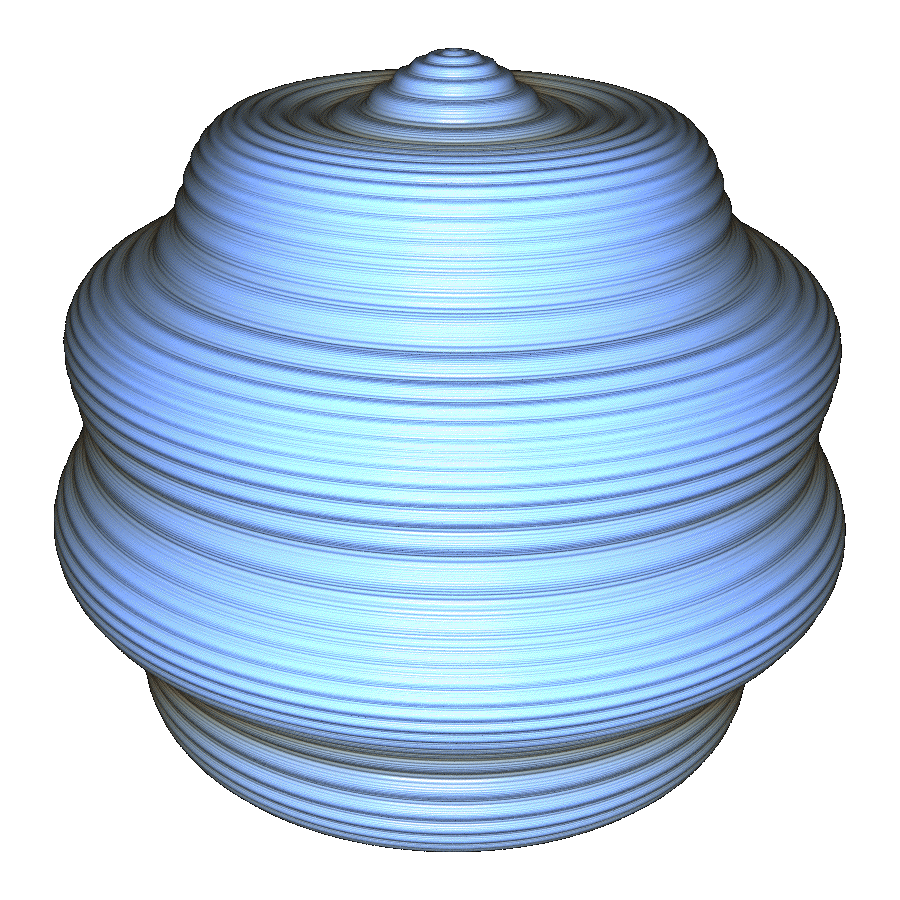
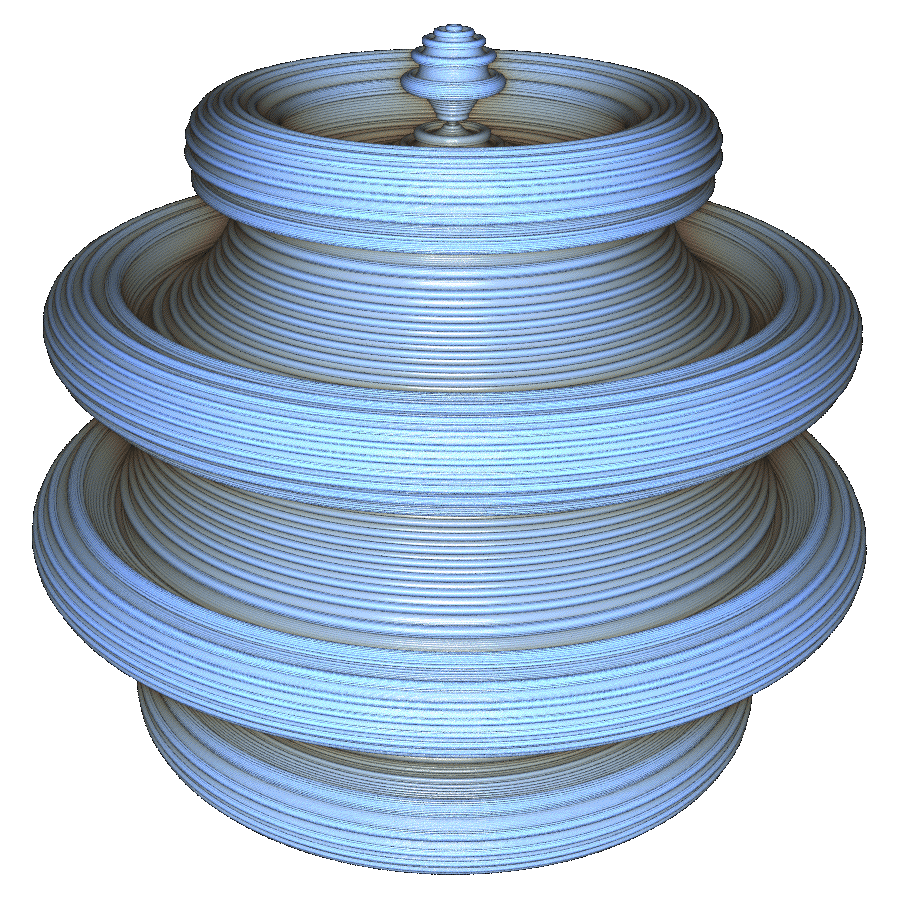
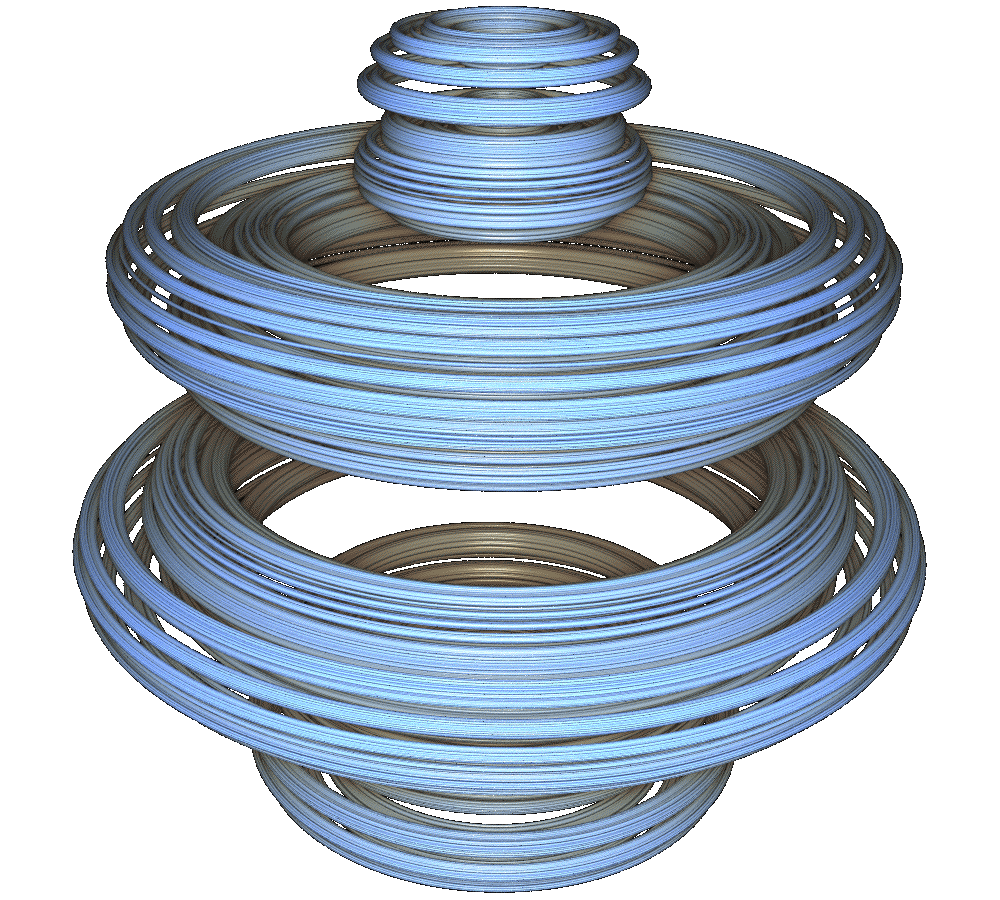
One unique property of Juliabulb sets is that when the Julia point is on the z axis (where the x,y coordinates are zero), it has circular symmetry. At the center C = (0, 0, 0), the Julia set is a perfect sphere as expected, since the constant offset is zero, so it simply exponentiates the radius, just as the Julia set at the center of the Mandelbrot set is a circle. However, any Julia point along the z axis, C = (0, 0, h) for any h ∈ ℝ, will make a beehive fractal of perfect circles! For example, C = (0, 0, 1), k = 8:
The proof is straightforward. Given the Mandelbulb equation in Julia set form, with the test point Z0 = (x, y, z)
Let ρn = |Zn|, φn = sin−1(
Then Zn+1 = ρnk(cos(kθn)cos(kφn), sin(kθn)cos(kφn), sin(kφn)) + C
Consider the set with a Julia point of C = (0, 0, h) for any h ∈ ℝ, and proceed by induction.
The base case is ρ0 =
Next, ρn+1 = |Zn+1| = |ρnk(cos(kθn)cos(kφn), sin(kθn)cos(kφn), sin(kφn)) + C|
Expand the Julia point, and simplify using the classic identity of sin2(θ) + cos2(θ) = 1
= |ρnk(cos(kθn)cos(kφn) + 0, sin(kθn)cos(kφn) + 0, sin(kφn) + h)|
= ρnk
= ρnk
= ρnk
At each iteration, ρn, which is the magnitude of Zn, does not depend on θ0, which is the longitude angle of Z0. The question of whether a point is outside the Julia set is determined by if ρn diverges toward infinity. Since ρn does not depend on θ0, if a point Z0 = (ρ0, φ0, θ0) is inside, then all points on the circle (ρ0, φ0, t) ∀ t ∈ ℝ are inside, and if Z0 is outside, then all points on the circle are outside.